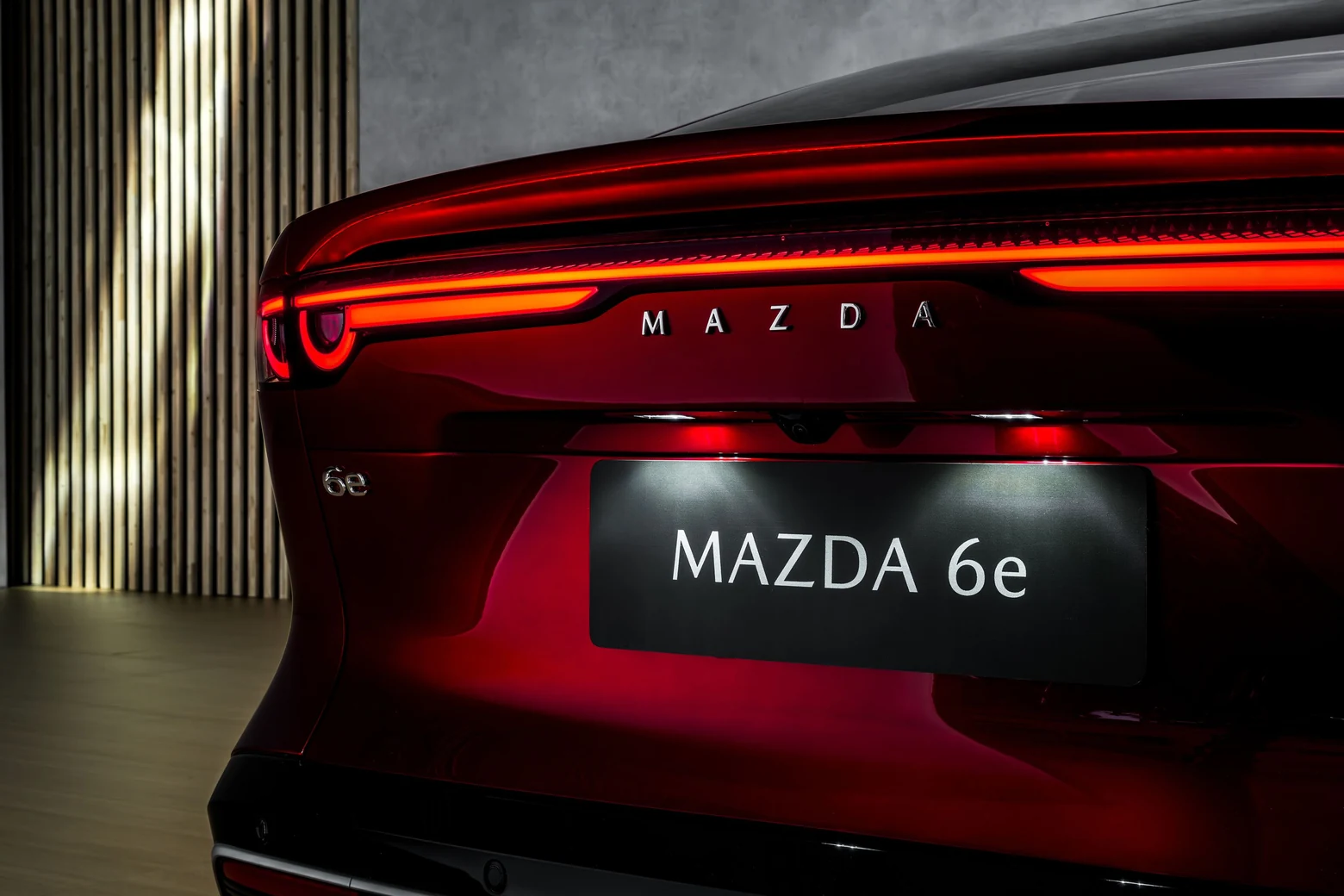
Pull up behind a 6e at dusk and you’ll know it’s a Mazda before you’re close enough to read the badge. That thin strip of red light could belong to any number of electric cars. The two round lamps at either end? They give the game away.
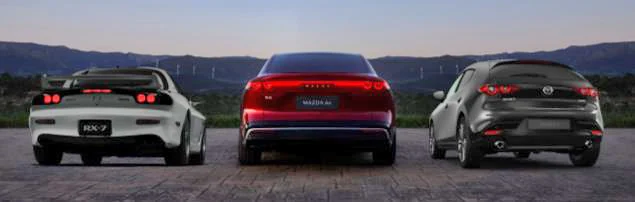
The man behind them is Yoshito Iwauchi. He led the design of the 6e, and buried in his account of the project is a photograph we wish more people could see. Three Mazdas, parked side by side, all facing away from the camera. It tells you more about this car than the usual shot of one sweeping through a bend.
A family photograph.
That’s an RX-7 on the left. A Mazda3 on the right. Between them sits the electric 6e. Try covering the badges with a finger. Your eye still goes straight to the two pairs of circles. The rotary sports car, the little hatch and the electric five-door could hardly have less in common mechanically. At a set of lights, they’re family.
Iwauchi says the resemblance was deliberate. What’s lovely is how little of the old cars his team needed to borrow. The RX-7 carries its lights in a dark band. On the 6e, a fine red line runs across the tail and seems to thread the circles together. You can enjoy the shape without knowing a thing about rotary engines. If you did once own an RX-7, well, there’s a little something here for you.
It also answers a fair question. When two companies build an electric car together, where does one partner’s work end and the other’s begin? In Mazda’s case, you can start with the tail-lights. Then follow the light along the doors.
A trick of the light.
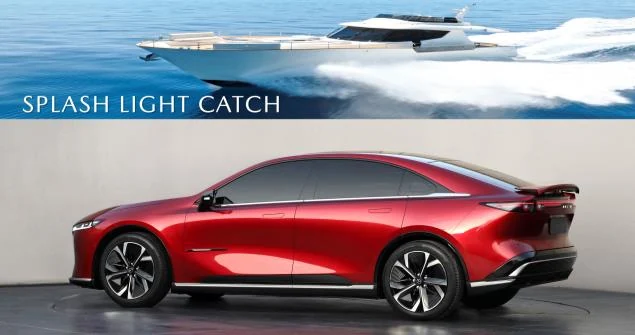
Look at the white streak beneath the hull in the designer’s illustration. Now look at the streak beneath the doors. The team took its cue from a speedboat throwing spray. Once you’ve seen the two together, a patch of reflected sky on the side of a red car takes on a life of its own.
It was also a solution to a fairly stubborn problem. The 6e grew out of the SL03 architecture from Mazda’s Chinese partner, Changan. The distance between the axles was set. So was the side glass. Iwauchi couldn’t push the front wheels forward or lower the roof until the proportions pleased him. He could change where the light fell.
See how the bright lower panel takes your eye back towards the rear wheel, while the shoulder above it catches a second, softer reflection. Ninety cars were eligible for this year’s design award. We wonder how many of the judges spotted the boat.
Behind the wheels.
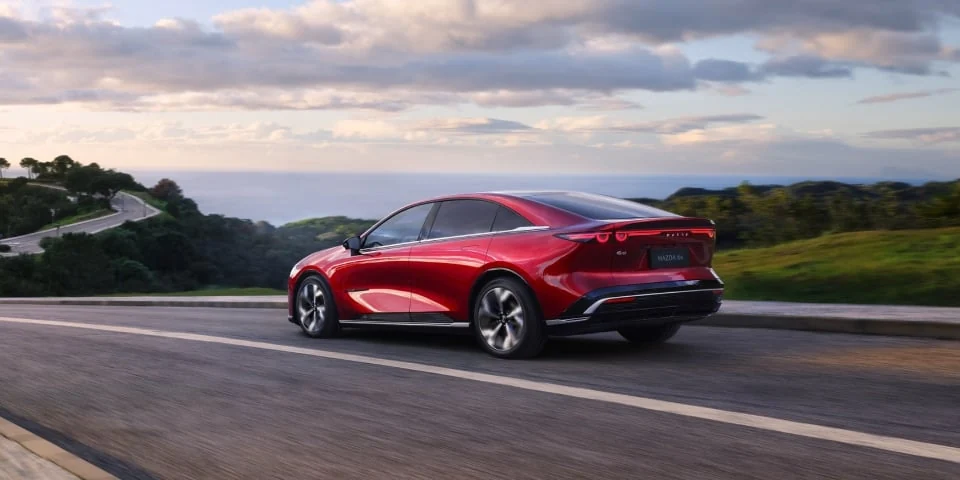
There’s another group at Mazda that deserves a mention. Its work is considerably harder to photograph. The European engineering team went back through the suspension, changing the dampers and the bushes that sit between moving parts. They fitted a stronger rear subframe and beefed up the anti-roll bars. A lot of work to hide behind a set of wheels.
Did it pay off here? Australian road tests generally agree the 6e is quiet around town and takes the bumps out of the daily commute. That might sound like modest praise until you think how much of a family car’s life is spent doing exactly that.
We’d take the dealership route that includes the patched-up corner you drive every Tuesday. You already know what your own car does there. Finding out what the Mazda does with the same piece of road is worth more than another sprint away from the lights.
Open the fifth door.
From the side you’d swear it had a conventional boot. Open it and the back window goes up with the lid. You have a much bigger opening to work with, particularly if the object in question is an awkward box and the person helping you pack has already gone back inside.
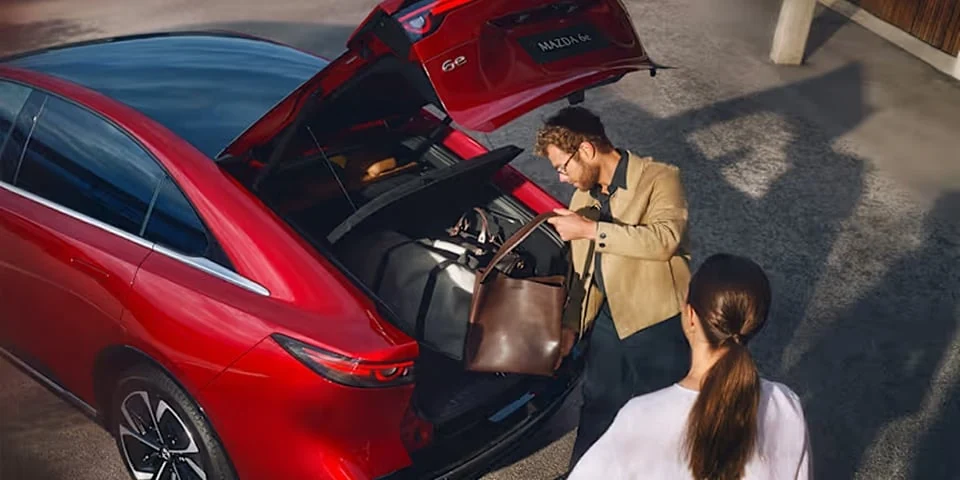
Mazda quotes 337 litres below the parcel shelf, including underfloor storage. Fold the rear seats, load to the roof and there’s 1,074 litres. Another 72 litres live under the bonnet. We’d put the charging cable there. The one time you need it will inevitably be the time it’s underneath everything else.
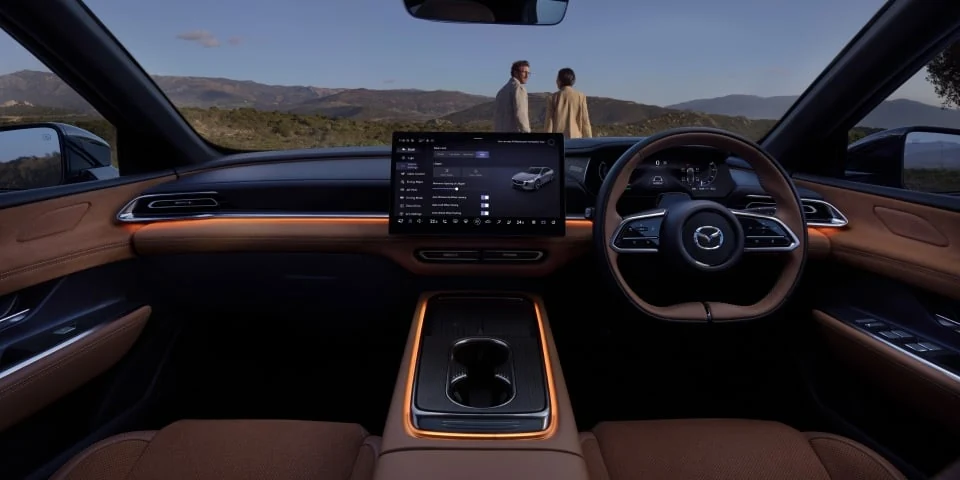
Up front, the tan leather and quilted synthetic suede are good reasons to look at the Atenza. Even the GT gets heated and ventilated front seats and an electric blind for the glass roof. One thing we’d change? Warming the steering wheel means opening the cabin menu and scrolling to the bottom. On a Melbourne winter morning, we’d happily trade a few pixels for a switch.
If you loved your Mazda6.
There’s a particular Australian buyer we reckon Mazda has done a favour. They’ve owned a Mazda6, enjoyed sitting low and liked the look of it on the driveway. Now they want to go electric. Mazda Australia has put something in the showroom for that person, right down to a price that makes a test drive a reasonable proposition.
At the time of writing, Mazda lists the 6e GT from $52,990 drive-away, with premium paint extra. Both GT and Atenza get the same 190 kW motor driving the rear wheels and the same 78 kWh battery. Buy the tan seats if you love them. You get the full driving hardware either way.
The claimed combined WLTP range is 560 km. For a trip, the more useful figure might be Mazda’s estimate of 24 minutes from 10 to 80 per cent on a suitable DC fast charger, conditions permitting. That’s the number we’d pencil in next to the coffee stop.
And if someone asks what you’ve bought, send them a photograph. Take it from the back.