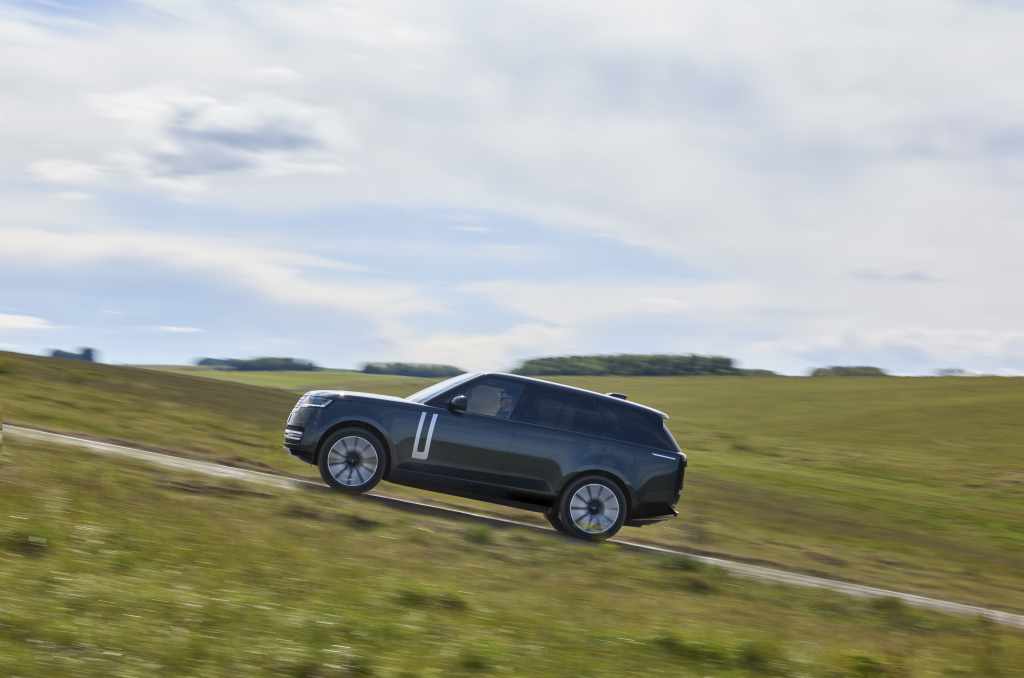
The first AC/DC-charged Range Rover.
For decades, Range Rover has worked very hard to stop you noticing what’s happening under the bonnet. Less noise. Less vibration. More effortless progress.
Now it has removed the engine altogether.
You do wonder whether this was the answer all along.
The Range Rover Electric keeps the familiar shape and imposing presence, while promising a quieter, smoother way of moving it around. That feels like a sensible use of electric power. A luxury car should make life less demanding.
And if part of the appeal is arriving in a Range Rover, the badge and silhouette are still doing their job. You don’t need an exhaust note to announce yourself.
TURN IT DOWN. TURN IT UP.
The AC/DC reference works at the charger. Alternating-current (AC) charging covers the usual home and destination stops; direct-current (DC) charging handles rapid public top-ups. The battery stores the energy and supplies the electric drivetrain.
Range Rover’s Australian website quotes a full charge in about seven hours using a suitable 22kW AC installation, or around 19 hours at 7kW. Not every home can supply 22kW, so the installation matters.
On a compatible 350kW DC charger, the manufacturer claims 10–80 per cent in around 22 minutes under suitable conditions. That is a useful touring figure, provided the charger can deliver and the battery is ready to accept it. A peak charging number is not the speed maintained throughout a stop.
Meanwhile, the drivetrain’s quoted 405kW and 850Nm suggest that quiet need not mean leisurely.
BRITISH ENGINEERING. WHOSE CELLS?
JLR says the motors and battery pack are its own designs. Packs and electric drive units are manufactured in Wolverhampton, with the vehicle built at Solihull.
The cells inside that pack are a separate question.
In a July 2025 interview with CarExpert, chief engineer Lynfel Owen said JLR was working with an established cell partner but could not name it. CarExpert publisher Alborz Fallah speculated that the supplier could be BYD. That was the publication’s assessment, not a supplier announcement from JLR.
A possible Chinese cell supplier does not make this a rebadged Chinese vehicle. Designing the pack, managing its temperature, controlling the motors and integrating everything into a Range Rover remain substantial engineering tasks.
Elsewhere in the family, the Chinese partnership is explicit. The revived Freelander brand combines JLR’s design direction with Chery’s electrified architecture and technology through their joint venture. That is a different arrangement from the Range Rover Electric’s own development programme.
THE RANGE IN RANGE ROVER
The Australian website advertises up to 600km. Local launch reporting identifies that claim as measured under the New European Driving Cycle (NEDC), so it should not be compared directly with figures from the Worldwide Harmonised Light Vehicles Test Procedure (WLTP).
Either way, a laboratory figure is not a promise of highway distance with passengers, luggage and the air conditioning doing its job. Australian touring consumption and a proper charging curve will tell us more.
Range Rover also claims a 900mm wading capability. The intended message is clear: changing the propulsion should not change where a Range Rover can go.
Whether its owner intends to go there is another matter.
THE PRICE OF A QUIETER LIFE
Australian pricing starts at $317,718 before on-road costs for the HSE. Autobiography is $357,718 and SV is $417,418. First local deliveries have been reported for the first half of 2027, with precise timing still to be confirmed.
At this money, refinement is expected. So is dependable ownership.
Electric propulsion removes some of the machinery that needs servicing, but reliability belongs on the list of things to establish over time. A quieter Range Rover is a credible promise. A more reliable one still needs evidence.
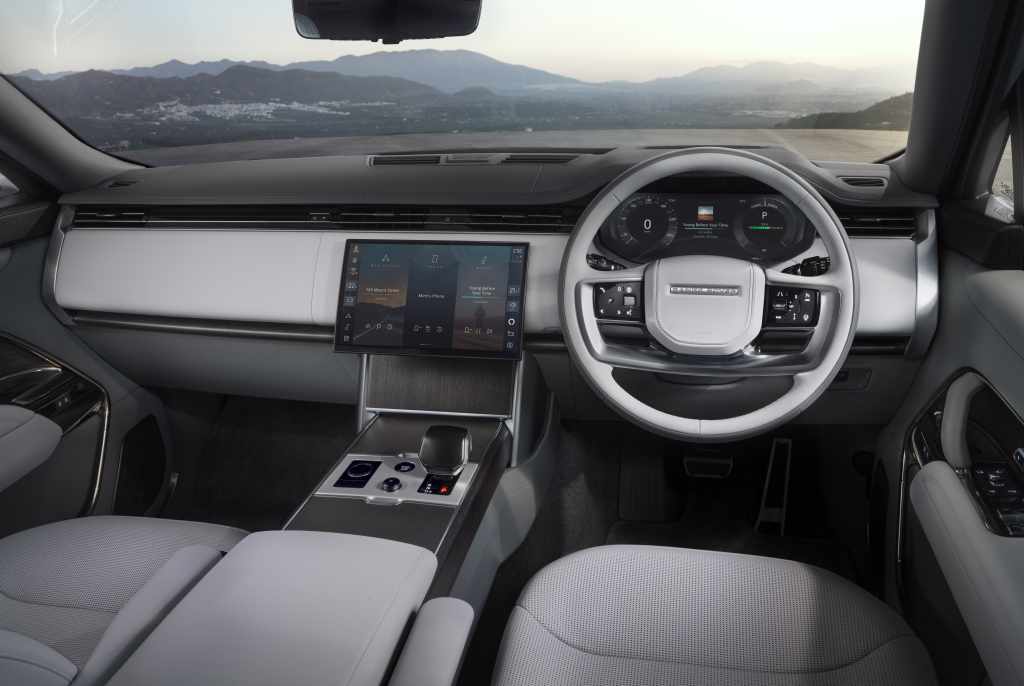
What interests us is how naturally the electric proposition fits the car’s purpose. Effortless response. A calm cabin. Plenty in reserve. All the presence people buy a Range Rover for, with less disturbance for the people inside.
We’ll need to drive it to judge the ride, consumption and controls. But the idea makes sense before a wheel turns.
High voltage outside. Volume down inside.
Images: Range Rover / JLR manufacturer publicity photography. Overseas vehicles shown; Australian specification may differ.