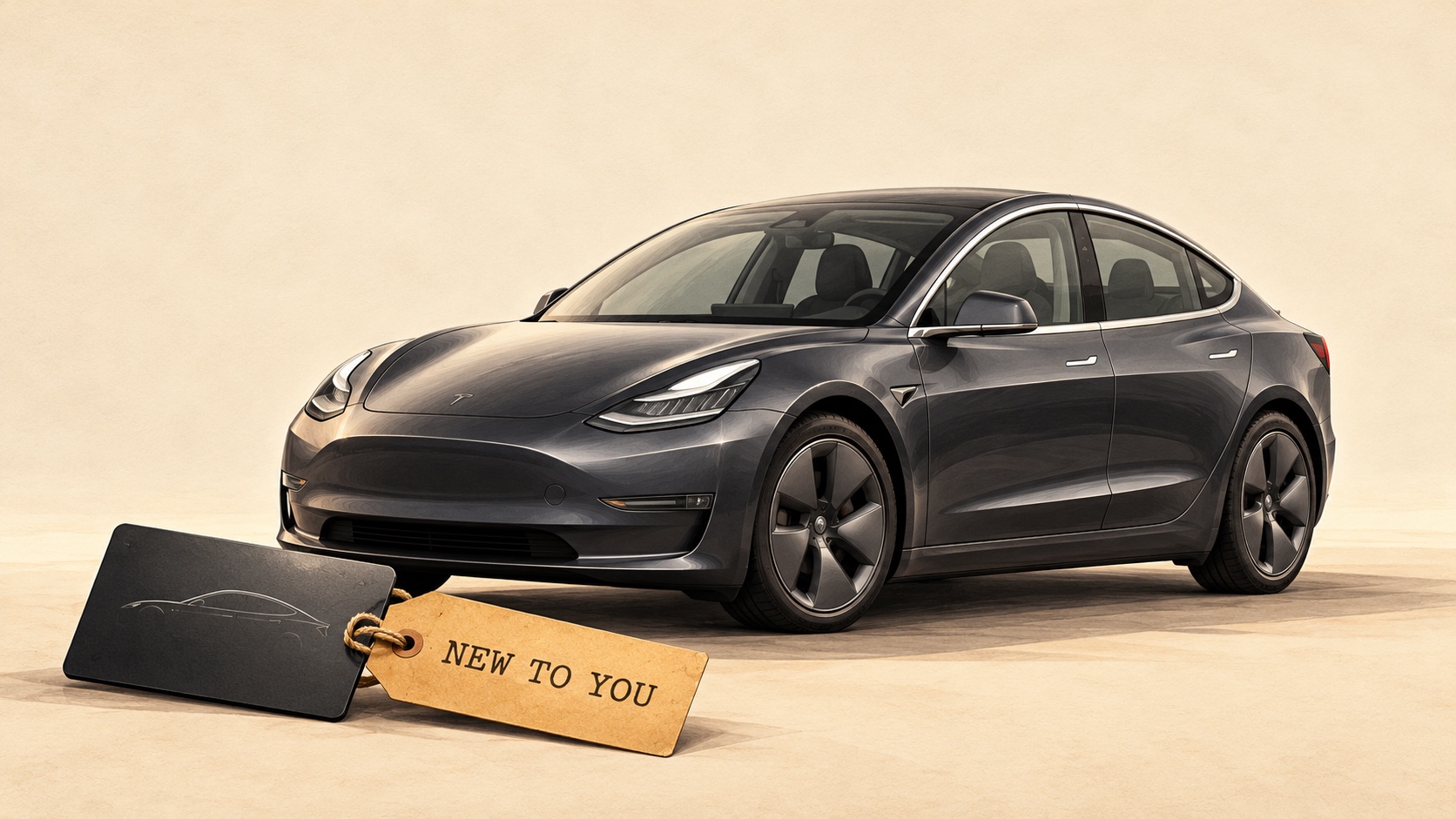
Your first electric car might already have its first owner.
A 2020 Tesla Model 3 Standard Range Plus. An advertised 73,755km. A private seller in New South Wales. An asking price of $25,500, excluding government charges.
That is the listing in a Carsales screenshot supplied to WattCar.
It is enough to make you pause before signing for something new.
It is not enough to tell you whether to buy this particular car. We have not inspected it, tested its battery or confirmed that it remains available. The figure is an asking price captured in the screenshot, not a completed sale or a drive-away quote.
But it is a useful starting point for a much bigger question.
Could the best electric car for your money already have somebody else’s name in its service history?
The attraction is obvious. Depreciation that was painful for the first owner can be rather helpful to the next. A fixed budget may stretch to a larger car, different equipment or a model you preferred but could not afford new.
The sensible comparison is with what that money buys today. The original sticker price is interesting history. It does not settle the current value.
And used does not automatically mean cheapest.
BYD currently advertises the new Atto 1 Essential at $19,990 drive-away for eligible retail buyers, subject to availability and offer conditions.
That smaller city car and a used Model 3 answer different needs. Which is precisely why the comparison is worth making. A new-car warranty and a smaller footprint on one side; the appeal of a larger used sedan on the other.
Ask what you need the car to do before deciding which price looks clever.
The used market is becoming harder to ignore. The Australian Automotive Dealer Association and AutoGrab reported 25,417 used fully electric vehicle sales in the first half of 2026, up 54.6 per cent on the same period a year earlier. The figures are listing-based market estimates, rather than a count of confirmed ownership transfers.
Pickles also reported a record quarter, selling more than 440 used electric vehicles in July–September 2026. Its used EV price index nevertheless eased between May and September. More activity does not mean every car is rising in value, and auction results are not retail asking prices.
For a buyer, the opportunity is choice. The job is to separate an attractive advertisement from a good car.
Start with the battery.
Ask for a battery health report for the actual vehicle, ideally supported by an independent inspection. Battery state of health (SoH) describes remaining capacity relative to its original condition. The age and odometer are useful context, but neither is a battery test.
You can pay a specialist to check it. AVILOO is an independent battery-diagnostics system used by several Australian inspection services. A tester connects to the car’s diagnostic port and produces a report on its high-voltage traction battery, rather than just its small 12-volt battery.
In South Australia, RAA advertises its AVILOO battery health check at $199 for members or $215 for non-members. In Melbourne, RideCheck advertises a mobile battery-only test at $249, with possible travel fees. Sydney Hybrid & Electric Cars in Wetherill Park advertises an AVILOO FLASH test at $275 including GST.
Confirm that the exact model is supported, the location is covered and the quote includes a written report. Ask what the particular test measures: current capacity, cell condition, fault indicators and comparison with similar cars. A quick diagnostic assessment is different from a longer test that measures usable energy during discharge.
Most importantly, this is a health check, not a crystal ball. It cannot promise how many years the battery will last or rule out every future failure. Use the result alongside warranty checks and a full vehicle inspection. A battery-only test does not inspect the rest of the car.
The screenshot lists an estimated 415km range. We would not treat that as a promise of what this six-year-old car will do now. The screenshot does not establish the test cycle, battery condition or the conditions behind that number.
Work out the range your ordinary week needs, then leave room for the longer trip, bad weather and a less convenient charging stop. Confirm that the car’s current capability suits those journeys.
Next, the warranty.
Ask to see the coverage attached to that individual car, its original delivery date and the remaining time and kilometre limits. Battery and drive-unit cover are different from general vehicle cover. Today’s Tesla new-car warranty should not be applied retrospectively to a 2020 car.
Tesla directs owners to the vehicle’s own warranty documents and the Specs & Warranty section of its app. Its additional used-vehicle warranty is for qualifying cars purchased directly from Tesla. A private advertisement is not the same proposition.
Then do the ordinary used-car work.
Arrange an inspection by someone familiar with electric vehicles. Check tyres, suspension, brakes, air-conditioning, charging equipment, repair records and the condition underneath. Try the controls and confirm charging operation. An electric badge does not excuse worn tyres or accident damage.
Check the vehicle identification number against the car and documents. A Personal Property Securities Register search can identify registered security interests and available stolen or written-off information. The official online search costs $2; the register recommends searching on the day before or the day of purchase.
Get an insurance quote for the exact car before deciding what you can afford. Add transfer charges, any immediate repairs and the charging arrangement you will actually use. A headline saving can shrink once the whole bill is on the table.
So, is this $25,500 Model 3 a bargain?
From a screenshot, we cannot say.
Is it the sort of proposition that makes a used electric car worth putting on the shortlist?
Absolutely.
Our view: the strongest used-EV buy is a car whose condition you can establish, whose range and charging fit your life, and whose total cost leaves a worthwhile advantage over the new alternatives you would seriously consider.
If that advantage is small, the certainty of buying new may be worth more. If it is substantial, you may be able to let somebody else absorb the expensive first chapter.
The best new thing in your driveway might not be new at all.
Image: WattCar, AI-created editorial illustration. Not the advertised vehicle. Listing details are from a screenshot supplied to WattCar; price and availability may change.
Price note: BYD’s offer ends 15 December 2026, with delivery required by 31 December. Availability and eligibility conditions apply; metallic paint costs extra. Battery-test prices are providers’ advertised figures and may change.